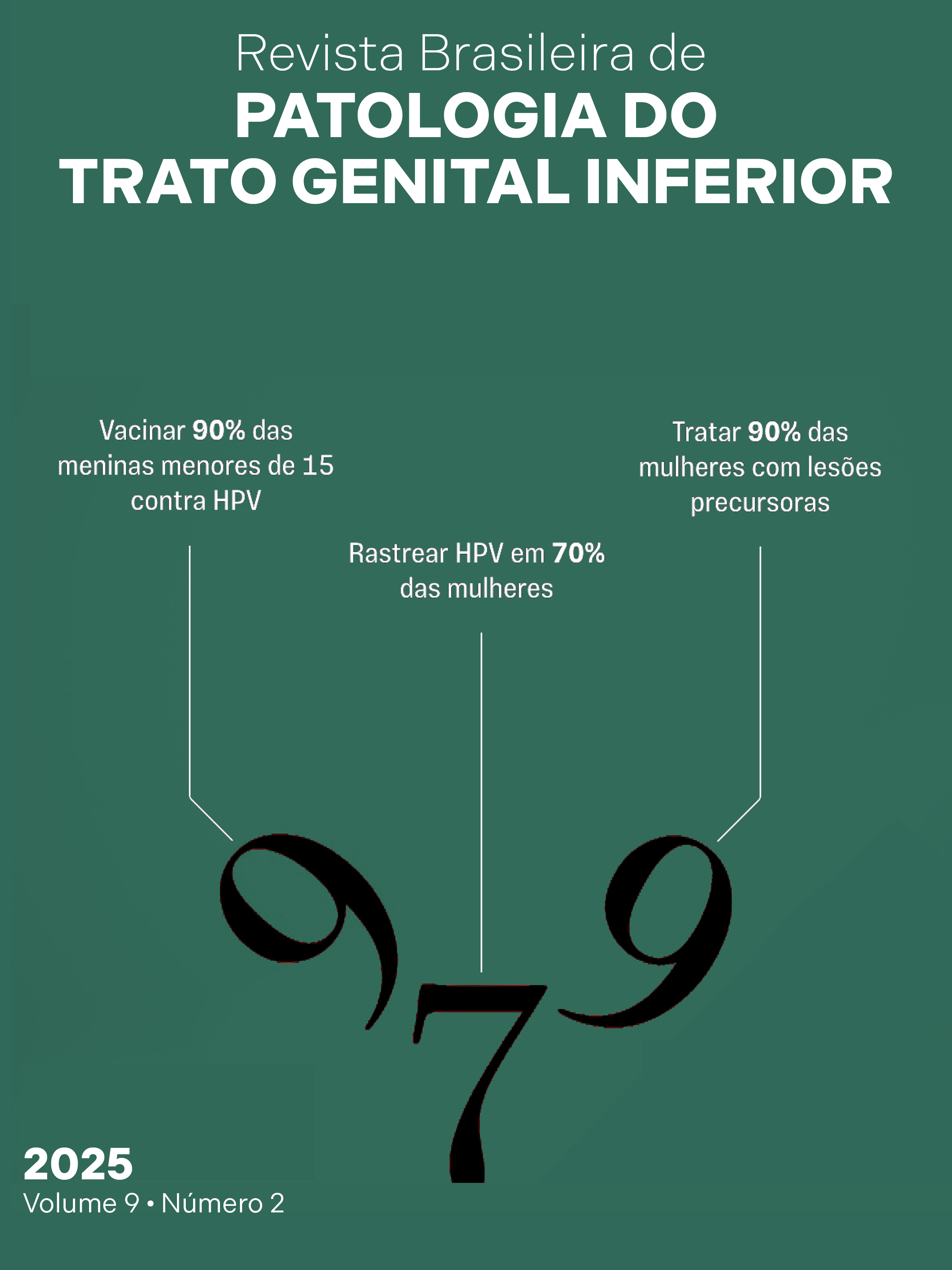
O uso de p16ink4a, Ki-67 e p53 em patologia do trato genital inferior
DOI:
https://doi.org/10.5327/2237-4574-142Resumo
***
Referências
Darragh TM, Colgan TJ, Cox JT, Heller DS, Henry MR, Luff RD, et al. The lower anogenital squamous terminology standardization project for HPV-associated lesions: background and consensus recommendations from the College of American Pathologists and the American Society for Colposcopy and Cervical Pathology. Arch Pathol Lab Med. 2012;136(10):1266-97. https://doi.org/10.5858/arpa.LGT200570
Eleutério J Jr, Giraldo PC, Gonçalves AK. Marcadores imunoistoquímicos de lesões precursoras do câncer do colo uterino associadas ao HPV: o papel da proteína de supressão tumoral p16ink4a. J Bras DST. 2006;18:62-65.
Cavalcante DIM, Linhares IM, Pompeu M, Giraldo PC, Eleutério J Jr. The utility of p16 INK4a and Ki-67 to identify high-grade squamous intraepithelial lesion in adolescents and young women. Ind J Pathol Microbiol. 2021:55(3):339-342. https://doi.org/10.4103/0377-4929.101740
Harper DM, Paczos T, Ridder R, Huh WK. p16/ki-67 dual stain triage of individuals positive for HPV to detect cervical precancerous lesions. Int J Cancer. 2025;156(12):2257-2264. https://doi.org/10.1002/ijc.35353
Zhou R, Wei C, Liu J, Luo Y, Tang W. The prognostic value of p53 expression for patients with cervical cancer: a meta analysis. Eur J Obstet Gynecol Reprod Biol. 2015;195:210-213. https://doi.org/10.1016/j.ejogrb.2015.10.006