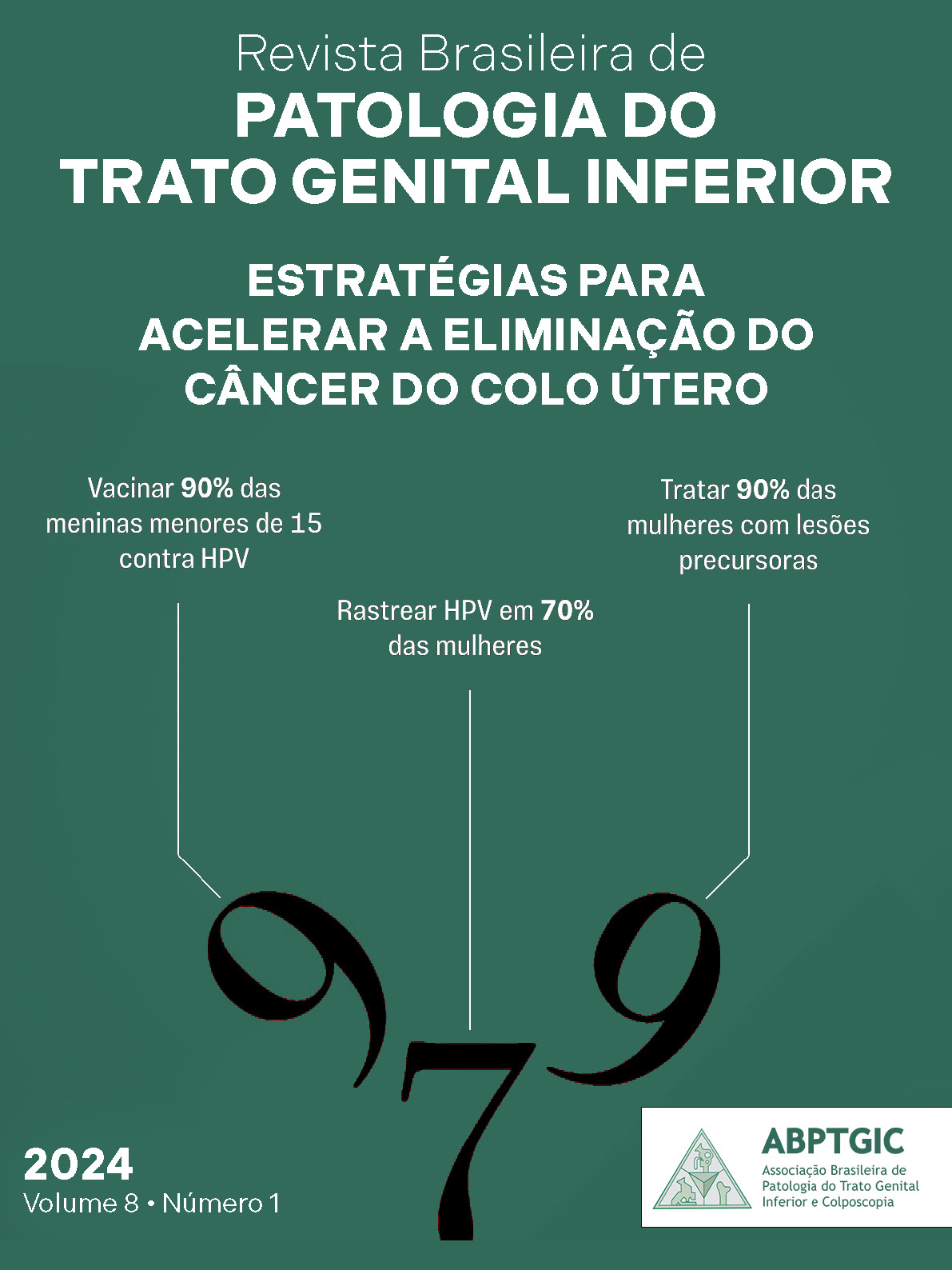
HPV testing in the office
DOI:
https://doi.org/10.5327/2237-4574-2024810005Keywords:
human papillomavirus viruses, human papillomavirus DNA tests, screeningAbstract
HPV is the main cause of cervical cancer in Brazil, requiring early detection for effective monitoring. HPV vaccination and DNA-HPV testing are crucial to reduce the incidence and mortality of cervical cancer, aligned with the WHO's eradication goals by 2030. DNA-HPV testing is more sensitive than cytology and can be combined with it for spaced screening intervals. New technologies, such as extended genotyping and dual-color staining tests, are being introduced to enhance HPV detection. DNA-HPV testing is recommended in cases of atypical squamous cells of undetermined significance and for post-treatment lesion monitoring. Implementing DNA-HPV testing as primary screening can be crucial in reducing cervical cancer, in line with WHO targets, awaiting widespread adoption in Brazil.
References
Instituto Nacional de Câncer José Alencar Gomes da Silva. Estimativa 2023: incidência de câncer no Brasil. Rio de Janeiro: INCA; 2023.
World Health Organization. Global strategy to accelerate the elimination of cervical cancer as a public health problem [Internet]. Geneva: WHO; 2020. [cited 2024 Jun 16]. Available at: https://www. who.int/publications/i/item/9789240014107
Perkins RB, Guido RS, Castle PE, Chelmow D, Einstein MH, Garcia F, et al. 2019 ASCCP risk–based management consensus guidelines: updates through 2023. J Low Genit Tract Dis. 2024;28(1):3-6. https://doi.org/10.1097/LGT.0000000000000788
Wright T, Stoler MH, Behrens CM, Sharma A, Zhang G, Whirgt TL. Primary cervical cancer screening with human papillomavirus: end of study results from the ATHENA study using HPV as the first-line screening test. Gynecol Oncol. 2015;136(2):189-97. https://doi.org/10.1016/j.ygyno.2014.11.076
Speck NMG, Carvalho JP. Dossiê de estratégias do rastreamento do câncer de colo uterino no Brasil. [acessado em 2024 maio 10]. Disponível em: https://www.febrasgo.org.br/pt/noticias/item/456-dossie-de-estrategias-do-rastreamento-do-cancer-de-colo-uterino-no-brasil
Demarco M, Hyun N, Carter-Pokras O, Raine-Bennett TR, Cheung L, Chen X, et al. A study of type-specific HPV natural history and implications for contemporary cervical cancer screening programs. EClinicalMedicine. 2020;22:100293. https://doi.org/10.1016/j.eclinm.2020.100293
Arbyn M, Smith SB, Temin S, Sultana F, Castle P. Detecting cervical precancer and reaching underscreened women by using HPV testing on self samples: updated meta-analyses. BMJ. 2018;363:k4823. https://doi.org/10.1136/bmj.k4823
Wentzensen N, Garcia F, Clarke MA, Massad LS, Cheung LC, Egemen D, et al. Enduring Consensus Guidelines for Cervical Cancer Screening and Management: introduction to the scope and process. J Low Genit Tract Dis. 2024;28(2):117-23. https://doi.org/10.1097/lgt.0000000000000804
Bonde JH, Sandri MT, Gary DS, Andrews JC. Clinical utility of human papillomavirus genotyping in cervical cancer screening: a systematic review. J Low Genit Tract Dis. 2020;24(1):1-13. https://doi.org/10.1097/lgt.0000000000000494
Graça J, Preti M, Pollano B, Vieira-Baptista P. Performance of different follow-up strategies and genotype-based recurrence risk after treatment of cervical high-grade squamous intraepithelial lesion. J Low Genit Tract Dis. 2024;28(2):131-6. https://doi.org/10.1097/lgt.0000000000000803